

Publish a data feed: let people run your widget without your key
A widget built on your Binance or OANDA connection used to be unusable by anyone else. Now you can publish exactly the reads it makes as a cached, read-only endpoint under your own profile — no key shared, no open proxy.
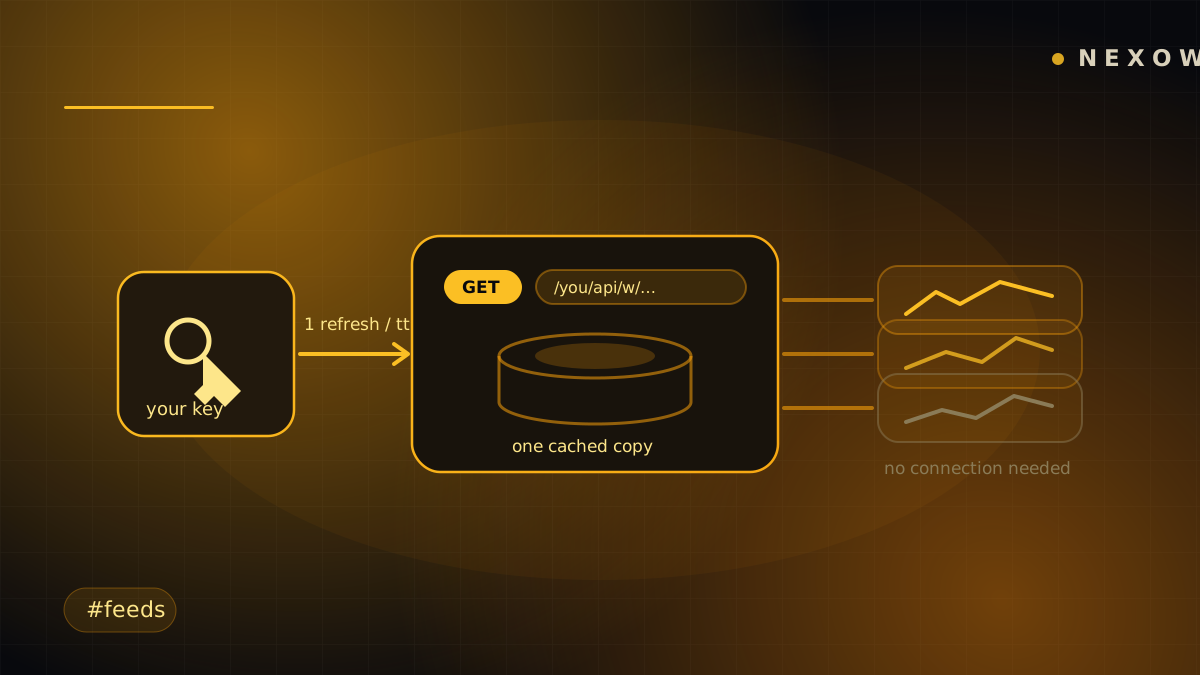
There was an awkward gap in sharing. You build a beautiful FX chart on your OANDA connection, publish it, and the first person who installs it sees Connect OANDA to use this data — which is a polite way of asking a stranger to open a brokerage account in order to look at a chart. Shared on a live screen it was worse: the widget froze to a thumbnail.
The fix isn’t to lend people your key. It’s to publish the reads your widget actually makes, as their own endpoints, under your own profile:
GET /<username>/api/w/<widget>/<endpoint>?symbol=EUR_USD&interval=H1Turn it on from the publish dialog — Publish a read-only data feed — and viewers without their own connection read your feed instead of being asked to connect.
Three rules, and each one is a refusal
Only reads that are safe to share. Thirteen data methods can be published.
The rest are blocked, each for its own reason: account and positions are reads
too, but they return your balance, NAV, P&L and open book. order and
closePosition move money. upsert and delete destroy data. scrape bills a
third party per call. Plain http is already credential-free, so publishing it
would only build an open proxy with your name on it.
Only the calls the widget actually made. Your widget’s successful reads are recorded as it runs, and the publish dialog shows you the list — candles from Binance — BTCUSDT, 1h — as the concrete thing you’re agreeing to. A request that asks for a parameter you never published, or a value outside the set you widened it to, is refused before anything is decrypted. Parameters that shouldn’t be in a URL at all — a SQL string, a query vector — never appear in one; they’re replayed verbatim from storage.
Refusals are indistinguishable. An endpoint that doesn’t exist, a parameter outside its enum, and an audience you’re not in all return the same 404. Whether a friends-only feed exists is itself something about the author, so the answer never leaks it.
Who can read it, and what it costs you
The audience isn’t a fourth switch to forget about — it follows the announcement post: anyone, your followers, or your friends. A private announcement disables the feed entirely, because an announcement only you can see backing an endpoint other people call is incoherent.
Cost is the part worth understanding, because it’s the part people fear. You pick a refresh interval — every 30 seconds, 5 minutes, hourly or daily — and that is the most your connection can be used, however many people open the widget. Readers share one cached copy. Ten viewers and ten thousand viewers make the same number of upstream calls, and exactly one refresh per window is allowed to run even when several readers miss the cache at the same instant.
Your key never leaves the server. Your balance, positions and orders are never published. And the feed is bound to the listing: unlist the widget and the endpoints stop serving.
The viewer’s own connection always wins
A published feed is a fallback, never a substitute. If someone opening your widget has their own OANDA connection, the widget uses theirs — their account, their data, their rate limits. The feed is only consulted after the widget has failed to find a connection of its own, and a miss is silent: they see the ordinary connect this venue message rather than a new error to learn.
The same endpoints run through the real venue adapters the app already ships, so a published feed returns byte-identical shapes to what you saw when you built the widget — across every live venue in the catalog, with no per-venue special-casing.
What it deliberately won’t do
- A shared trading dashboard renders its chart, not its account panel. That’s the blocked list doing its job, not a bug.
- A symbol picker only offers the symbols you enumerated. A widget with a free-text input degrades to a fixed set. That’s the trade for not building an open proxy onto your broker.
- Privacy-mode authors can’t publish a feed. In privacy mode your credentials live only in this device’s seal — no server holds them, so no server can refresh anything on your behalf.
- A fork doesn’t inherit the feed. Feeds are bound to a widget’s lineage, so every installed copy resolves the same endpoints and a fork resolves none.
It’s a small thing to switch on, and it changes what publishing means: a widget you share is now a widget people can actually run.
Launch Nexow, open a widget you built on a keyed connection, and publish it with the feed switched on.
Build your first widget in the next minute
Open the preview, describe one useful thing, and place it on your canvas.